|
|








In 2005 when I first heard about the painted Caribou coats I was researching my own aboriginal
roots and a seed was planted in my mind. I would design a line of clothing and accessories
based on these coats. I kept the idea alive by reading any new piece of information on the
internet and jotting down my ideas. It was my goal to have some pieces of work ready for our
gallery in Cartwright at its 10th anniversary.
As often happens with design ideas, they change, get added to, you face reality. I downsized my ideas, up scaled them, brought in the element of canvas Cossacks, and actually began the process of producing a couple of prototypes - jewelry, in 2008.
The drawing became more important than the actual garments. I sat back and looked at what I had on paper. I could see pendants, broaches, hair pieces. I wore my first piece to get comments, what people liked, their reaction.
One young lady looked at it and said she could see it as a motif on the sleeve of a woman's cut tee shirt. Bing! All of those sketches, a new life.
Where am in the design plan now? I have focused on a small number of the images, interpreted some, copied others and will have a few pieces ready for our gallery, Mealy Mountain Gallery, by our 10th year, 2009.
The designs for this artwork is based on the Innu pishakanakup (Caribou Skin Coat).
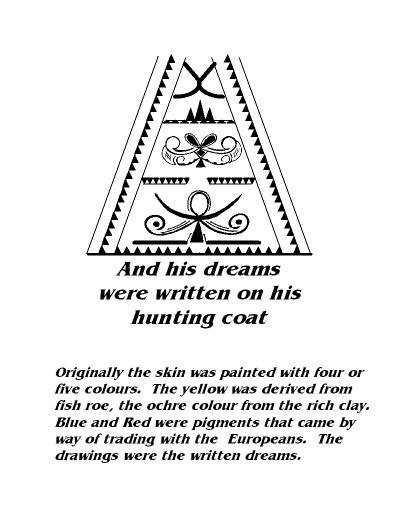
The painted Innu coats represent the rich culture of the Innu worn by the Naskapi, Montagnais, and Cree Hunters of the Quebec-Labrador Peninsula of Labrador. The coats were the interpretation of a hunters dreams, a tribute to the caribou, a sign of respect. They were constructed and painted by the women
Originally the skin was painted with mainly 4 - 5 colours. The yellow was derived from fish roe, the ochre colour from the rich clay. Blue and Red were pigments that came by way of trading with the Europeans. The drawings were the written dreams.
"Colour was carefully applied with a bone stylus instead of a brush; parallel lines were drawn with a stylus shaped like a fork. The yellow colour was made of fish-roe, black from burnt bones, most of the red pigments was acquired from fur traders. The reddish-brown around the upper part of the sleeves is a native pigment, absent on later coats. The total absence of "laundry blue" supports the pre-1850 origin of this coat. All the pigments, including the imports, were held in a fish-roe binding medium. …The off-white colour of the tanned skin is the symbol for caribou, and also in other parts of the Canadian North the Indians have stated that the caribou are attracted by white dress. Basic to many of the painted designs is a double curve, symbolic of caribou antlers. Parallel lines stand for trails of the caribou herds, and for tracks of toboggans loaded with meat. Red paint symbolized blood. The sophistication of women's aesthetic values are manifest in this art work. In prayer and blessings the new coat acquired magical powers to ensure success in hunting, though these powers were believed to disappear gradually" (William Jamieson Tribal Art)
After curing the caribou skin and cutting/sewing it, the coat would be painted. The hunter's wife would paint the coat while in a tent, or possibly outside. The basic elements of the painted designs follow two main styles - the "double curve" and the "quadrate layout". Within those styles there are about a dozen different design elements that she painted. She and her husband jointly chose which designs elements to best record the dream. She then painted those elements on the coat, using about a half dozen different kinds of "standard" paint sticks/applicators" (Kevin McAleese, The Rooms)
I have been fascinated by the double curve for years so that was where I began. I read Symbols of North America by Heika Owusu and To Please the Caribou by Dorothy Burnham. All of my readings on the subject have influenced my design.
Pete Barrett
As often happens with design ideas, they change, get added to, you face reality. I downsized my ideas, up scaled them, brought in the element of canvas Cossacks, and actually began the process of producing a couple of prototypes - jewelry, in 2008.
The drawing became more important than the actual garments. I sat back and looked at what I had on paper. I could see pendants, broaches, hair pieces. I wore my first piece to get comments, what people liked, their reaction.
One young lady looked at it and said she could see it as a motif on the sleeve of a woman's cut tee shirt. Bing! All of those sketches, a new life.
Where am in the design plan now? I have focused on a small number of the images, interpreted some, copied others and will have a few pieces ready for our gallery, Mealy Mountain Gallery, by our 10th year, 2009.
The designs for this artwork is based on the Innu pishakanakup (Caribou Skin Coat).
The painted Innu coats represent the rich culture of the Innu worn by the Naskapi, Montagnais, and Cree Hunters of the Quebec-Labrador Peninsula of Labrador. The coats were the interpretation of a hunters dreams, a tribute to the caribou, a sign of respect. They were constructed and painted by the women
Originally the skin was painted with mainly 4 - 5 colours. The yellow was derived from fish roe, the ochre colour from the rich clay. Blue and Red were pigments that came by way of trading with the Europeans. The drawings were the written dreams.
"Colour was carefully applied with a bone stylus instead of a brush; parallel lines were drawn with a stylus shaped like a fork. The yellow colour was made of fish-roe, black from burnt bones, most of the red pigments was acquired from fur traders. The reddish-brown around the upper part of the sleeves is a native pigment, absent on later coats. The total absence of "laundry blue" supports the pre-1850 origin of this coat. All the pigments, including the imports, were held in a fish-roe binding medium. …The off-white colour of the tanned skin is the symbol for caribou, and also in other parts of the Canadian North the Indians have stated that the caribou are attracted by white dress. Basic to many of the painted designs is a double curve, symbolic of caribou antlers. Parallel lines stand for trails of the caribou herds, and for tracks of toboggans loaded with meat. Red paint symbolized blood. The sophistication of women's aesthetic values are manifest in this art work. In prayer and blessings the new coat acquired magical powers to ensure success in hunting, though these powers were believed to disappear gradually" (William Jamieson Tribal Art)
After curing the caribou skin and cutting/sewing it, the coat would be painted. The hunter's wife would paint the coat while in a tent, or possibly outside. The basic elements of the painted designs follow two main styles - the "double curve" and the "quadrate layout". Within those styles there are about a dozen different design elements that she painted. She and her husband jointly chose which designs elements to best record the dream. She then painted those elements on the coat, using about a half dozen different kinds of "standard" paint sticks/applicators" (Kevin McAleese, The Rooms)
I have been fascinated by the double curve for years so that was where I began. I read Symbols of North America by Heika Owusu and To Please the Caribou by Dorothy Burnham. All of my readings on the subject have influenced my design.
Pete Barrett
Mealy Mountain Gallery
The designs for this artwork are based on the Innu
pishakanakup (Caribou skin coat). The painted coats
represent the rich Innu culture. They were worn by Naskapi,
Montagnais and Cree Hunters of the Quebec-Labrador
Peninsula. The coats were the interpretation of a hunter's
dream, a tribute to the caribou, a sign of respect. They were
constructed and painted by the women.
2012 winner
of the
Aboriginal
Woman
Entrepreneur
of the Year
Award for
Atlantic
Canada
2012 winner of
the Aboriginal
Woman
Entrepreneur of
the Year Award
for Atlantic
Canada
Pete Barrett